
Committed to Samoan RSE workers and employers
15 April 2026
When Tanuvasa Tomasi Peni took on the newly created role of Samoan labour mobility officer for Recognised Seasonal Employer (RSE) workers in the South Island, he brought his absolute passion for achieving the best outcomes for employers and workers.
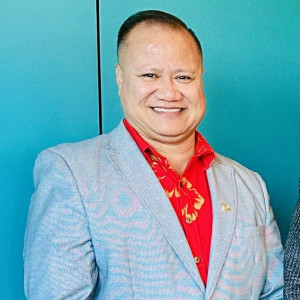 His role is critical to managing worker welfare, fostering employer partnerships and promoting training initiatives.
A major initiative that Peni - currently also overseeing the North Island -- has introduced is visiting every Samoan team in the country on a quarterly basis. He meets with all workers and employers and seeks their feedback on how things are going and to hear about any concerns or ideas for improvement.
This enables him to compile a detailed report for the Samoan Government and the Ministry for Business, Innovation and Employment, to inform the very best policy for the RSE scheme.
Over three weeks each quarter, Peni visits workers and employers in more than 60 RSE businesses in about 16 different areas of New Zealand.
“The initiative came about through thinking outside the box about how I could capture as much feedback as possible to evaluate each year,” says Peni, who took on the role in 2023.
“We do a questionnaire at the end of the summer and winter seasons, but I recognised that meeting workers and employers in person and seeing them in the workplace and the accommodation provided for them is the best way to capture any concerns and bring up things we may not have explored before.
“It means I can see first-hand that employers are applying policies fairly and following the principles of the interagency agreement. It is an acknowledgement of what employers are achieving, and I include all of them in my report, particularly the compliance aspect.”
Peni had previously worked as national coordinator for Samoa for the International Labour Organisation (ILO).
“Labour mobility was my specialisation and after 10 years in policy development and having attended a lot of international labour conventions, I really wanted to get out in the field with workers and amongst the work they are doing. It was my passion to come to New Zealand to do that.”
Peni says the goals of the initiative includes promoting close collaboration between RSE employers and partners in the scheme.
“Meeting up with me is an opportunity for employers to review what they are doing, look at what is working well and anything that is missing or any issues. For workers, it is to promote harmonious living conditions and support them in working hard.
“Between 3,000 and 4,000 Samoan RSE workers come to New Zealand each year. There are different teams for the summer and winter seasons. I make sure I see each season’s workers and I always visit everyone again just before Christmas.
“I haven’t had any negative feedback from employers about the initiative and workers are very positive about it.”
Travelling around all the Samoan RSE worker locations regularly, Peni gets to see the strong bonds which are often forged between RSE workers and their employers.
Some employers are so highly regarded by their long-time workers that they get Samoan chiefly titles bestowed upon them.
“We have a very good relationship with employers. The bond you see between employers and workers is very special. Many employers learn a lot about Samoa and workers return year after year and I see employers treating them like family.
“In consultation with workers, I have informally bestowed Samoan chiefly titles on some RSE employers. For instance, Ross, the manager at Matipou Orchards in Hawke’s Bay, treats his RSE workers as if they were his own family.
“I was there recently and he was holding a celebration to mark one of his RSE workers having been returning to the orchard to work each year for 18 years.
“In discussion with the team, we agreed to informally bestow the chief title of Tagaloa on Ross. Samoan workers may not find it easy to pronounce European names, so they use the Samoan title for their manager instead (only used on the orchard; it is not an official title).
“I have done that for six RSE employers, but I know there are others, men and women, who have also had titles bestowed on them when visiting their workers’ villages in Samoa.”
Peni’s role also includes actively supporting, acknowledging and organising community activities for Samoan RSE workers.
He oversees a strong social media network for Samoan RSE employees and their families and runs a range of activities throughout the year.
These range from an online Christmas carol competition with Samoan RSE teams forming choirs and uploading their performances online, to participating in a volleyball tournament, with RSE workers travelling across the South Island to take part. These events attract significant interest from the wider Samoan community as well as media interest in Samoa.
“I also have a ‘gold medal’ scheme,” says Peni. “At the end of each season, teams get to see if they are ‘gold medal teams’. It attracts a lot of interest and inspires competitive spirit; the whole community gets to see on Facebook which teams have gained that status and they see it as a very strong motivation to work hard.
“Samoan RSE workers are very enthusiastic about having the opportunity to work in New Zealand. When I talk with them, I encourage them to think about that golden opportunity they have, think of their family as a priority and make the most of this chance. So many people in Samoa are looking for this opportunity and they feel very fortunate to have been chosen.”
Peni also works closely with the Samoan Trade Commissioner and Consult Commercial in the Samoa Consulate-General office in Auckland. This is an important part of his role, particularly when RSE policy is being discussed with the New Zealand Government.
“New Zealand’s RSE scheme remains a success story. It delivers essential labour for growers while providing valuable employment and income opportunities for Pacific communities.”